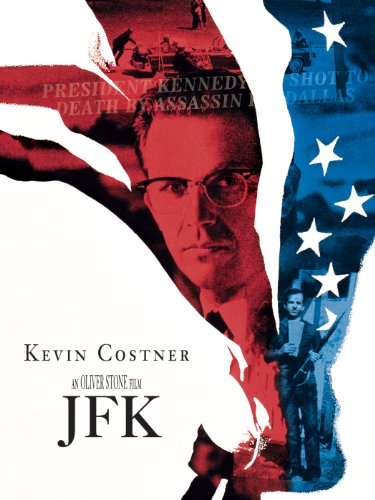
(Photo by Amazon.com)
JFK: More Than Just A Conspiracy
It is a
film about one of the most important events in the nation’s history. It is a film about one of the most disputed
events in the nation’s history. There is
no shortage of questions surrounding the 1963 assassination of President John
F. Kennedy. Director Oliver Stone is not shy of voicing his opinion over the
matter and he does so in one of his most important films, and maybe one of the
most important films of the last half of the 20th Century. One can
go online and find countless reviews of Stone’s 1991 film JFK, so I will try to
make this slightly original. What stands out most to me is that this movie
uncovers a larger problem than JFK, a problem of government secrecy.
First, I
will start my proclaiming my fascination with the films look inside the life of
New Orleans district attorney Jim Garrison and how he became obsessed with
finding answers to the mysterious assassination. Garrison did what many people
would never dream of doing, and that is to sacrifice his own “life” to uncover
and reverse something he felt was ruining the fabric of our country. Garrison
obviously didn’t sacrifice his life by means of death, but he sacrificed his
family life, his job and reputation in the search of what he thought was justice.
The task before him was monumental and perhaps unwinnable from the onset. He
never wavered though, as he began uncovering covert CIA operations and a paper
trail of evidence supporting something far more elaborate than what the
American people were being told. In a broader sense, his search was more for
truth in general than it was to find the real story behind that fateful day in
Dallas. It is this reason that I feel he succeeded and it is this part of the
JFK movie that I wish to expound upon.
For
some, this movie may have been a simple one, the question of who was really
behind the assassination. But for me, it was more than that, and I believe for
Jim Garrison it was more than that. What seemed to be frustrating Garrison the
most was that he was encountering so much resistance in his quest for answers
to his questions. While perhaps Garrison never found the truth he was looking
for, he most certainly uncovered the fact that the truth had not been fully
divulged by the government. His quote “telling the truth can be a scary thing
sometimes” sums up his plea to have some basic questions answered. Eyewitness
accounts never seemed to match up with the story the American people were told.
People were detained and questioned and released, the events of Lee Harvey
Oswald’s day did not make sense, nor did he even seem to be capable of pulling
off such an act. The parade route being rerouted at the last minute and the
fact that Presidential security was much less than it normally would have been,
are all reasons to believe that this was an event some, more than just one man,
knew was coming. It seemed every time Garrison stumbled upon something that did not
make sense, he found another and another.
The
culmination of Garrison’s efforts, the trial of Clay Shaw, seemed a bit
anticlimactic to me. It never seemed like Garrison really had a case against
Shaw and I never really thought he would get a guilty verdict. I am unsure that
Garrison himself even expected one. The most important part of the movie for me
was Garrison’s closing arguments where he talked of the erroneous “magic bullet
theory” and of how one day, his son could go into the National Archives and see
the files of what the CIA and FBI really knew. It was a gripping speech that
may have strayed from the objective of convicting Shaw, but hearkened us all to
stop and think about whether our government was telling us the truth and if
they weren’t, how come? This was more an attack on the US Government as a whole
than just on Clay Shaw.
Was
there a conspiracy to kill JFK that included top level government officials or
the FBI or CIA? I don’t believe we will ever know that for sure. But Jim
Garrison and Oliver Stone made it crystal clear that it is a distinct
possibility and I believe the movie was a referendum on government transparency.
I believe it did a lot of good too, or at least some. One benefit that came
from this film was the President John F. Kennedy Assassination Records Collection Act of 1992.
This act released for public availability a lot of the records and documents
pertaining to the assassination of Kennedy. The act itself stated that all
records be released, but everyone knows that they were not, in fact the
Assassination Archives and Research Center (AARC) has requested that the CIA
turn over some 50,000 pages of documents relating to the assassination.
(FOIA Blog) To add to that, and as Stone
points to in the film, even now public and most popular Warren Commission
documents are possibly filled with erroneous and forged testimony. Can we even
believe the documents that have been released, let alone how many have not?
Perhaps a little bit
of trust in the powers that be is in order to avoid going completely crazy, but
a bit of questioning is in order here. If Oliver Stone’s movie does nothing
else, it begs the question “what is our government not telling us and why.”

No comments:
Post a Comment